CT
AI Product
Jun 2026
The AI doesn't know your friend. You do. Knack just helps you say it.
Context
Knack is an AI gift-finding assistant I designed, built, and shipped solo.
Every other gift tool competes on catalogue size, Knack competes on helping an anxious gifter translate what they already know about someone into a confident, specific recommendation, with a transparent "why this fits" tied to their own words.
Impact
4.5/5
15 testers
Recommendation quality
100%
60% buy · 40% save
Acted on the result
<1wk
Solo build
Concept to live
Problem
Gift anxiety isn't a discovery problem
Meet the anxious gifter. They know the person, the inside jokes, the offhand comments, the things they're into, but freeze when it's time to turn that into an actual gift.
Every existing tool answers the wrong question. Marketplaces and quiz "gift finders" assume the problem is not enough options, so they pile on bigger catalogues, more filters, trending lists
01
Bigger catalogue
More to choose from = more paralysis, not less.
02
More filters
Asks the buyer to specify what they can't yet articulate.
03
Trending lists
Generic by definition — the opposite of personal.
The reframe
The AI does not know
the recipient. The buyer does
Most "AI gift" products try to make the model an
expert on a stranger, which it can't be.
Knack inverts that: the buyer is the expert, and the AI's only job is to lower the articulation barrier — draw out what they know, reflect it back, let them correct it. The thoughtfulness stays with the buyer.
Principle
Four rules that fall out of
that one idea
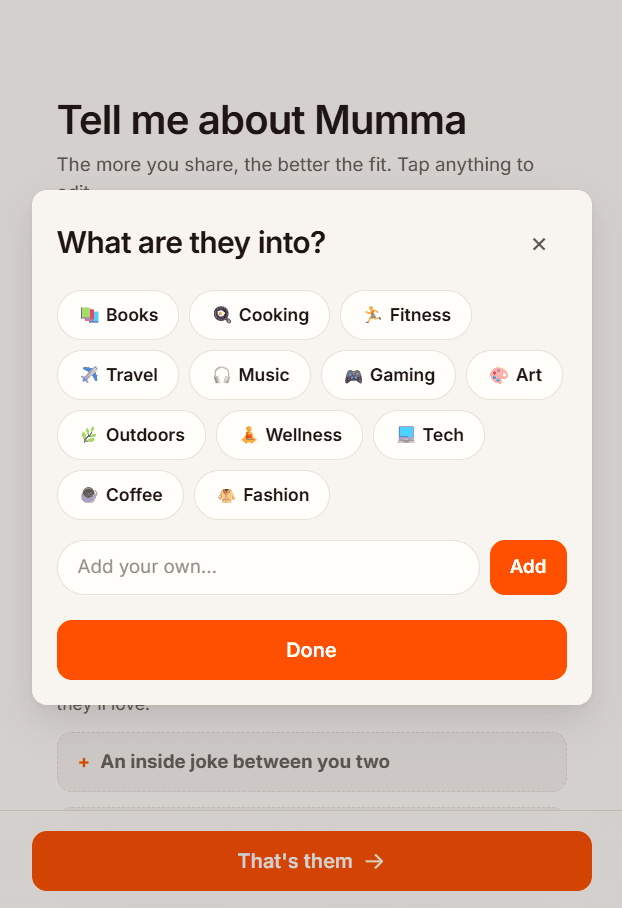
Elicit before recommend
Ask first. Never lead with products.
Lower the articulation barrier
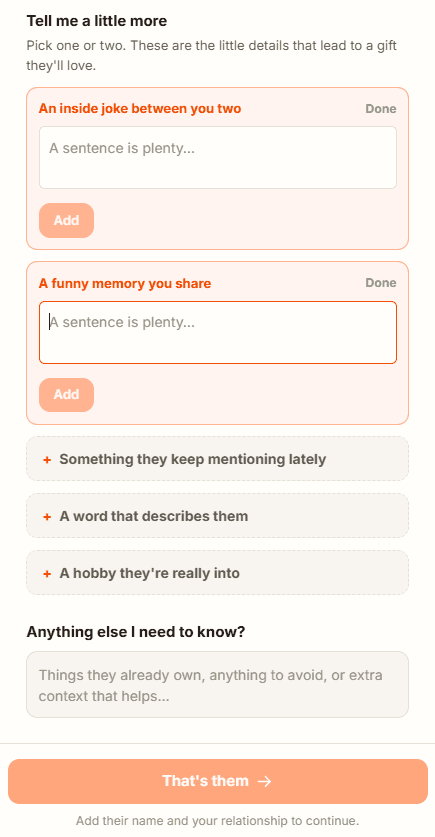
Free-type interests, plus guided "tell me more" prompts for blank-field freeze.
Reflect back, let them correct
Summarise what you heard; let the buyer fix it before recommending.
Keep thoughtfulness with the buyer
"Why this fits" quotes their words, not generic product copy.
The Experience
Elicit
Ask first. Never lead with products.


Reflect
Knack summarises what it heard and lets the buyer correct it before spending a recommendation on a wrong assumption.

Recommend
A few specific gifts, each with a transparent "why this fits" that quotes the buyer's own input.


Act
Buy or save. This is where the 100% action rate lives, 60% bought, 40% saved.

AI Product Decisions
Four calls that show product judgment,
not just an AI wrapper
01
Model evaluation, 9 LLMs, one production choice
Evaluated 9 models on a cost-benefit basis, recommendation quality against price per prompt, and chose Claude Sonnet 4.6 at $0.06/prompt.
Not the top benchmark score: the model that cleared the quality bar at a per-prompt cost a solo consumer app could sustain.

02
Honest AI, input-confidence guardrails
The fastest way to lose trust is a confident recommendation built on thin input. So when the buyer gives too little to go on, Knack asks for context instead of guessing.

03
Human-in-the-loop controls
AI output misses sometimes — so the buyer can always steer. Edit, regenerate, and correct controls let them recover and redirect, instead of being stuck with a wrong first pass.

04
Privacy & bias by design, zero persistence
Knack stores nothing, every session is in-memory only. A deliberate dual call: it protects the buyer's data, and it reduces bias, since no profile history nudges recommendations toward past behaviour.
Results
01
4.5/5 recommendation quality
From 15 informal testers.
02
100% action rate
Every tester acted on a result, 60% clicked buy, 40% saved.
03
Concept to live in under a week
Solo, built with Claude Code, shipped on Vercel.
What I Learned
01
Focus visibility is the foundation, not a detail
On a D-pad, get the focus system right and the
rest of the library has somewhere to stand.
02
A design system is a communication tool first
It was the shared language that let a solo designer hand off a full platform to engineering in twelve weeks.
03
Semantic colour makes density readable
Teal and red meaning the same thing on every screen is why officers could read a dense dashboard at a glance.
